SIEMOC vs. Splunk: Why we think differently
An honest review – not just an advert
Splunk is a major player in the SIEM market. Anyone involved in security monitoring, log management, threat detection or SOC processes will find it hard to ignore Splunk. The platform is powerful, offers extensive integration capabilities and is well established in many large organisations. Splunk Enterprise Security is officially described as a SIEM solution that collects, centralises and analyses security data in real time to detect, investigate and respond to threats more quickly. Newer Splunk offerings go a step further, combining SIEM, UEBA, SOAR, threat intelligence and AI-powered capabilities within an integrated security platform.
That’s impressive. However, it isn’t necessarily the right solution for every business.
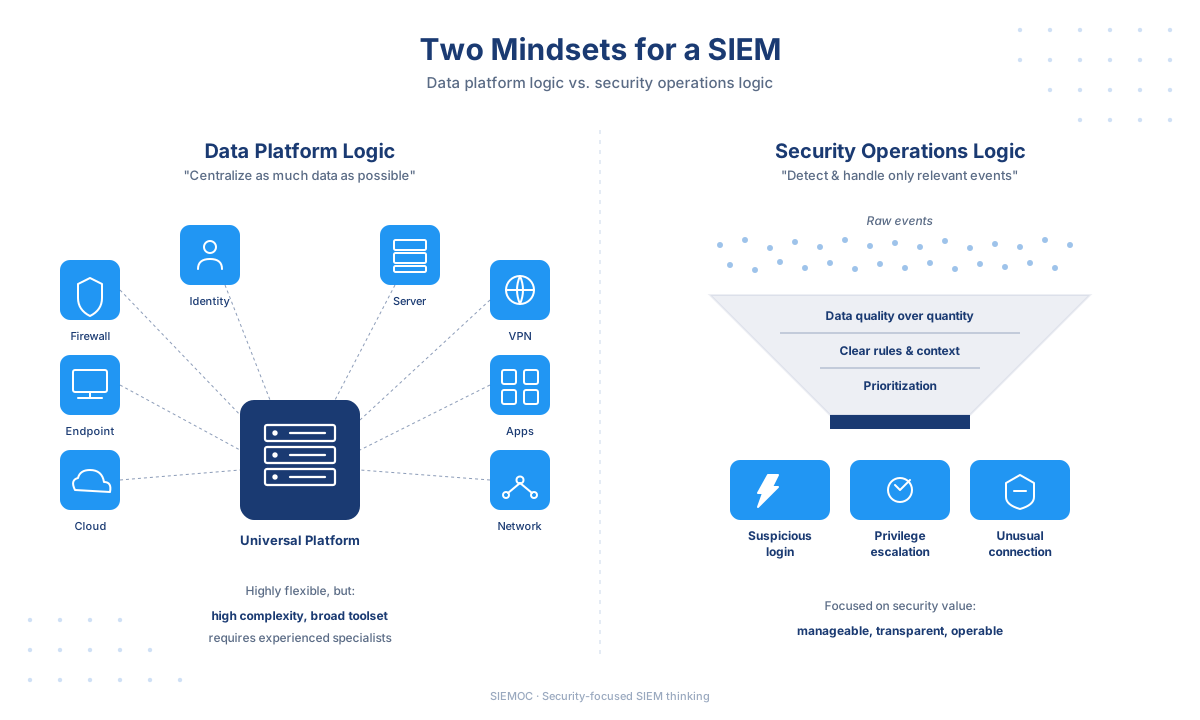
SIEMOC takes a different approach. Not because Splunk is ‘bad’, but because many organisations are not looking for the most complex security platform possible, but rather a transparent, manageable and cost-effective SIEM solution. This is precisely where the difference lies: Splunk thinks primarily from the perspective of a universal data and analytics platform. SIEMOC thinks more from the perspective of actual security operations.An honest review – not just an advert
Splunk is a major player in the SIEM market. Anyone involved in security monitoring, log management, threat detection or SOC processes will find it hard to ignore Splunk. The platform is powerful, offers extensive integration capabilities and is well established in many large organisations. Splunk Enterprise Security is officially described as a SIEM solution that collects, centralises and analyses security data in real time to detect, investigate and respond to threats more quickly. Newer Splunk offerings go a step further, combining SIEM, UEBA, SOAR, threat intelligence and AI-powered capabilities within an integrated security platform.
That’s impressive. However, it isn’t necessarily the right solution for every business.
SIEMOC takes a different approach. Not because Splunk is ‘bad’, but because many organisations are not looking for the most complex security platform possible, but rather a transparent, manageable and cost-effective SIEM solution. This is precisely where the difference lies: Splunk thinks primarily from the perspective of a universal data and analytics platform. SIEMOC thinks more from the perspective of actual security operations.
The starting point: SIEM is not an end in itself
A SIEM system should not be designed to store as much data as possible, generate as many dashboards as possible, or trigger as many alerts as possible. It should detect and assess security-related events and convert them into actionable incidents. This distinction may sound trivial, but in practice it is crucial.
Many SIEM projects fail not because of the technology, but because of overloading. Too many data sources are connected, too many use cases are launched simultaneously, too many correlations are defined, and too many expectations are placed on automation, AI and reporting. The result is often a system that is theoretically very powerful but remains difficult to manage in practice.
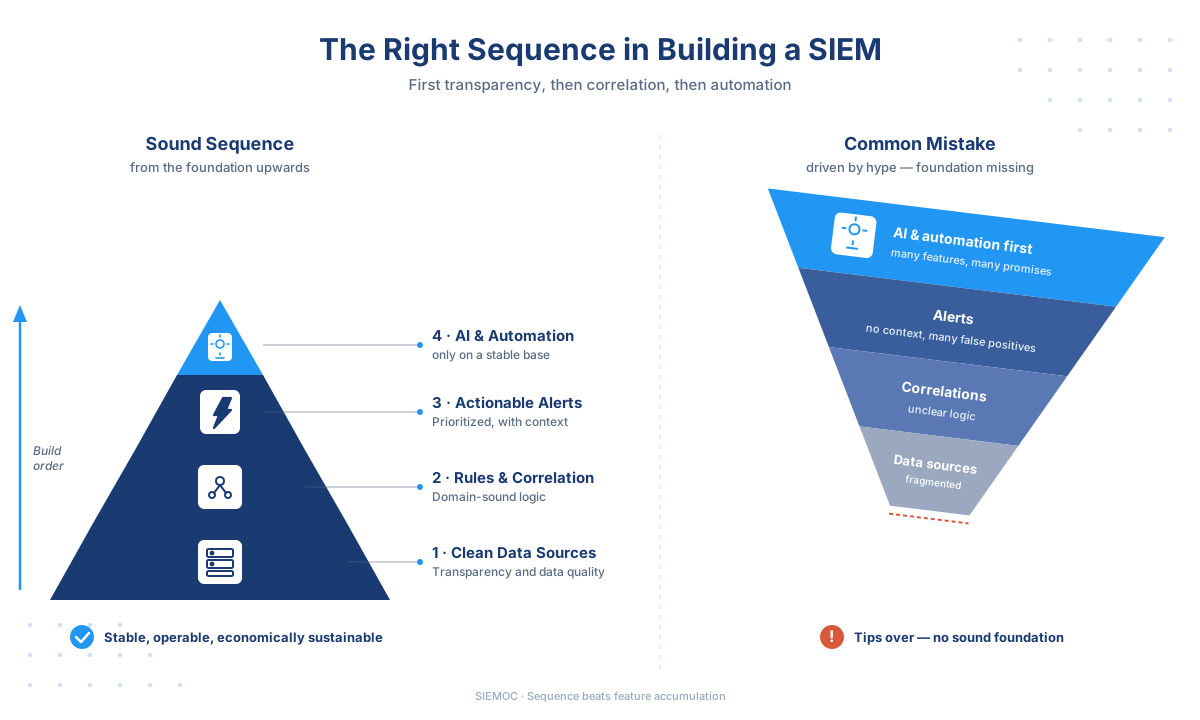
SIEMOC therefore takes a more pragmatic approach: first transparency, then correlation, then automation. The goal is not the largest possible platform, but a SIEM that is actually used in the day-to-day work of an IT or security team. This includes clean data sources, understandable rules, traceable alerts, clear escalation paths and an operational concept that works even without a large team of specialists.
Splunk: powerful, flexible, but demanding
Splunk’s strength lies in situations where large volumes of data from very diverse sources need to be flexibly searched, analysed and correlated. The platform is suitable for organisations with mature security operations processes, experienced analysts and complex requirements for search, reporting, detection engineering and incident response.
Splunk also offers various pricing models. In addition to volume-based ingest pricing, where daily data ingestion in GB plays a central role, Splunk also offers workload pricing, where the resources used for search and analysis workloads are the determining factor. This can be useful depending on the usage scenario, but requires careful planning. This is because data volumes typically grow rapidly in the SIEM environment: firewalls, endpoint systems, servers, cloud services, identity providers, VPNs, applications and network components continuously generate new events.
This is where one of the practical challenges lies. Splunk is capable of a great deal. But this capability must be planned, configured, operated and paid for. For large SOCs with specialised teams, this is often justifiable. For medium-sized enterprises, regulated organisations with limited resources, or IT teams without a dedicated detection engineering team, the barrier to entry can be high.
SIEMOC: focused on security rather than data maximalism
SIEMOC takes a different approach. The focus is not on the question: “How do we get as much data as possible into a central platform?” The more important question is: “Which security-relevant events do we need to detect, understand and act upon?”
This difference changes the architecture and operations. SIEMOC is designed to help organisations evaluate relevant security events from infrastructure, endpoints, servers, applications and network components in a structured manner. The focus is on the concrete benefits for security monitoring, compliance and incident response.
This does not mean that less data is inherently better. It means that data quality is more important than data volume. A precise alert regarding a suspicious login, an expansion of privileges, tampering with system files or a suspicious network connection is more valuable than thousands of unprioritised log lines without context. SIEMOC therefore focuses on manageable security information, not on data accumulation as an end in itself.
Comparison point 1: Target audience and operating model
Splunk is aimed particularly at organisations seeking a highly flexible data platform for security, observability and operational analytics. Splunk’s official communications position the company in both the security and observability sectors, emphasising its role as a platform for digital resilience, security analysis and performance transparency.
SIEMOC is aimed more at companies that require a SIEM with a clear security function: detection, alerting, analysis, traceability and compliance support. The focus is less on maximum platform breadth and more on manageable security monitoring operations.
This is a significant difference. Not every organisation needs a universal enterprise data platform. Many first need a reliable SIEM that makes relevant events visible, detects typical indicators of compromise and provides structured support for security processes.
Comparison point 2: Complexity
Splunk is highly flexible. This flexibility is a strength, but it can also create complexity. Anyone wishing to make full use of Splunk requires expertise in data modelling, search language, indexing, dashboards, correlations, use case development, licence management and operational architecture. This is normal in large environments, where there are often specialised roles for platform operations, detection engineering and SOC analysis.
SIEMOC focuses more on predefined security requirements. Which systems need to be monitored? Which security-related events are critical? Which alerts need to be escalated immediately? What compliance evidence is required? These questions form the starting point. This results in a clear, operationally focused structure.
The advantage lies in the lower complexity of getting started. Organisations do not first need to fully understand a universal data platform before they can begin security monitoring. SIEMOC aims to get organisations up and running effectively more quickly.
Comparison point 3: Cost structure
Costs are a sensitive issue in the SIEM environment because they are directly linked to data volumes, use cases and retention periods. Splunk offers various pricing models, including volume-based ingest pricing and workload pricing. With ingest pricing, licensing is based on daily data ingestion volumes; with workload pricing, the investment is based on the resources used for search and analysis workloads.
These models may be suitable in large enterprise scenarios, but they require discipline. Every additional data source, every new log class and every extended retention period can have an impact on architecture and costs. In SIEM projects in particular, this often leads to difficult decisions: Which logs are security-relevant? Which data is collected merely out of habit? Which sources generate high costs but yield little insight?
SIEMOC takes a more transparent, benefits-driven approach here. The focus is on determining which data is actually required for security monitoring and compliance. This often allows a SIEM project to be scaled in a more controlled manner. The economic assessment begins not only after the rollout, but right from the design of the data sources and use cases.
Comparison point 4: Detection and response
Splunk Enterprise Security offers comprehensive functions for detection, investigation and response. Splunk describes newer editions as platforms that combine SIEM, SOAR, UEBA, threat intelligence, detection engineering and embedded AI functions. For mature SOCs, this breadth can be very attractive.
SIEMOC takes a different approach. Many organisations initially require robust core capabilities: centralised security events, rule sets, alerts, dashboards, forensically usable information and traceable incident handling. Rather than introducing as many advanced features as possible at once, the focus is on practical feasibility.
This is not an argument against automation or AI. It is an argument for the right sequence. First, data sources must be properly integrated. Then the rules must be technically sound. After that, alerts must be operationally viable. Only on this basis do automation, anomaly detection or AI-supported analysis realise their true value.
Comparison point 5: Openness and control
A SIEM is a sensitive system. It processes security-related logs, potentially personal data, authentication events, system statuses and indications of attacks. Organisations must therefore understand exactly where data is stored, how long it is retained, who has access and how it is analysed.
Splunk can be deployed in cloud, on-premises or hybrid scenarios. For large organisations, this flexibility is an advantage. At the same time, architecture, licensing, operations and governance must be carefully planned.
SIEMOC places particular emphasis on controllable operating models. This is especially relevant for companies that place a high priority on data protection, regulatory requirements, internal security policies or digital sovereignty. A SIEM must not only be powerful, but also remain transparent and manageable.
Where Splunk has a clear advantage
An honest comparison must also highlight where Splunk is stronger. Splunk is the better choice if a company is looking for a very large, universal data platform that goes far beyond traditional SIEM requirements. Anyone wishing to consolidate security, observability, IT operations, business analytics and complex data analysis onto a single platform will find Splunk to be a very powerful tool.
Splunk can also be ideal for large SOCs with experienced analysts, in-house detection engineers and established processes. The platform offers enormous flexibility, a broad ecosystem, numerous integrations and a high level of market maturity. Those who make consistent use of these capabilities can build highly sophisticated security and analytics environments.
SIEMOC does not claim to replace Splunk in every area. That would be neither credible nor sensible. Its aim is different: SIEMOC is intended to be a strong alternative for companies seeking a focused, comprehensible and cost-effective SIEM solution.
Where SIEMOC plays to its strengths
SIEMOC is particularly strong when companies do not want an oversized platform, but rather a clear security monitoring system. Typical requirements include centralised analysis of security events, detection of suspicious activities, compliance support, alerting, reporting and incident analysis.
The advantage lies in focusing on the essentials. SIEMOC does not have to be everything: a data platform, observability suite, business analytics system and security orchestration solution all at once. It concentrates on the security benefits. This allows for a leaner implementation, more intuitive operation and more controllable day-to-day management.
This is particularly relevant for medium-sized enterprises, public sector organisations, regulated industries, or organisations with limited security resources. They do not need a SIEM that only works with a large team of specialists. They need a system that improves their security posture without overburdening operations.
The real difference: a conceptual model rather than a feature list
The comparison between SIEMOC and Splunk cannot be decided solely on the basis of feature tables. Of course, functions are important: log sources, correlation, dashboards, alerting, reporting, threat intelligence, access control models and integrations. But the conceptual model is more crucial.
Splunk operates from the breadth of a powerful data platform. This is legitimate and very successful in many enterprise scenarios.
SIEMOC approaches things from the perspective of a pragmatic security operation. Which risks need to be identified? What data is required for this? Which alerts warrant action? Which processes need to be supported? What costs are sustainable in the long term? What level of complexity can the team realistically manage?
This difference does not automatically make SIEMOC better. But it does make SIEMOC a better fit for certain organisations.
Conclusion: Bigger isn’t better, but more suitable
Splunk is a mature, powerful and market-leading platform. Anyone requiring maximum flexibility, large volumes of data, a broad ecosystem and enterprise-wide analytical capabilities should seriously consider Splunk. Mature SOCs and large organisations in particular can benefit greatly from it.
SIEMOC deliberately takes a different approach. The emphasis is on focused security monitoring, traceable operations, manageable complexity and cost-effective implementation. This makes SIEMOC particularly suitable for companies that view a SIEM not as a major platform project, but as a concrete tool for improving their security posture.
The best comparison therefore does not end with “SIEMOC is better than Splunk” or “Splunk is better than SIEMOC” . The more honest answer is: Splunk is strong when an organisation can and wants to operate a large, flexible data platform. SIEMOC is strong when a company is looking for a clear, operationally viable and security-oriented SIEM.
That is precisely why we think differently. Not against Splunk. But closer to the operational needs of many companies.
Interesse am Thema? - Reden Sie mit uns!
Get in touch